
Why research peptides are supplied freeze-dried
Freeze-drying (lyophilisation) keeps peptides stable during transport and storage. This note explains why.
Why research peptides are supplied freeze-dried
Research peptides are freeze-dried (lyophilised) because removing free water strongly slows chemical degradation of the peptide, allowing the material to remain stable for longer during storage and transport than in dissolved form.
The freeze-drying process
Freeze-drying is a drying technique in which an aqueous peptide solution is first frozen and then placed under vacuum. At low pressure and low temperature, the frozen water sublimates, meaning it passes directly from solid to gas phase without a liquid intermediate. This occurs in two stages: primary drying, during which most of the frozen water sublimates, and secondary drying, during which remaining bound water is removed at a slightly higher temperature. The result is a porous, amorphous solid with a very low residual moisture content.
Stability without free water
Many peptide degradation pathways, such as hydrolysis of peptide bonds, deamidation of asparagine and glutamine residues, and oxidation of susceptible side chains, proceed through reactions in which water molecules act as a reactant or as a mobile phase for reactive species. Removing free water strongly limits molecular mobility within the material, which slows these degradation pathways. A freeze-dried peptide in powder form therefore has a considerably longer stability period under suitable storage conditions than the same peptide in aqueous solution.
Transport and shelf life
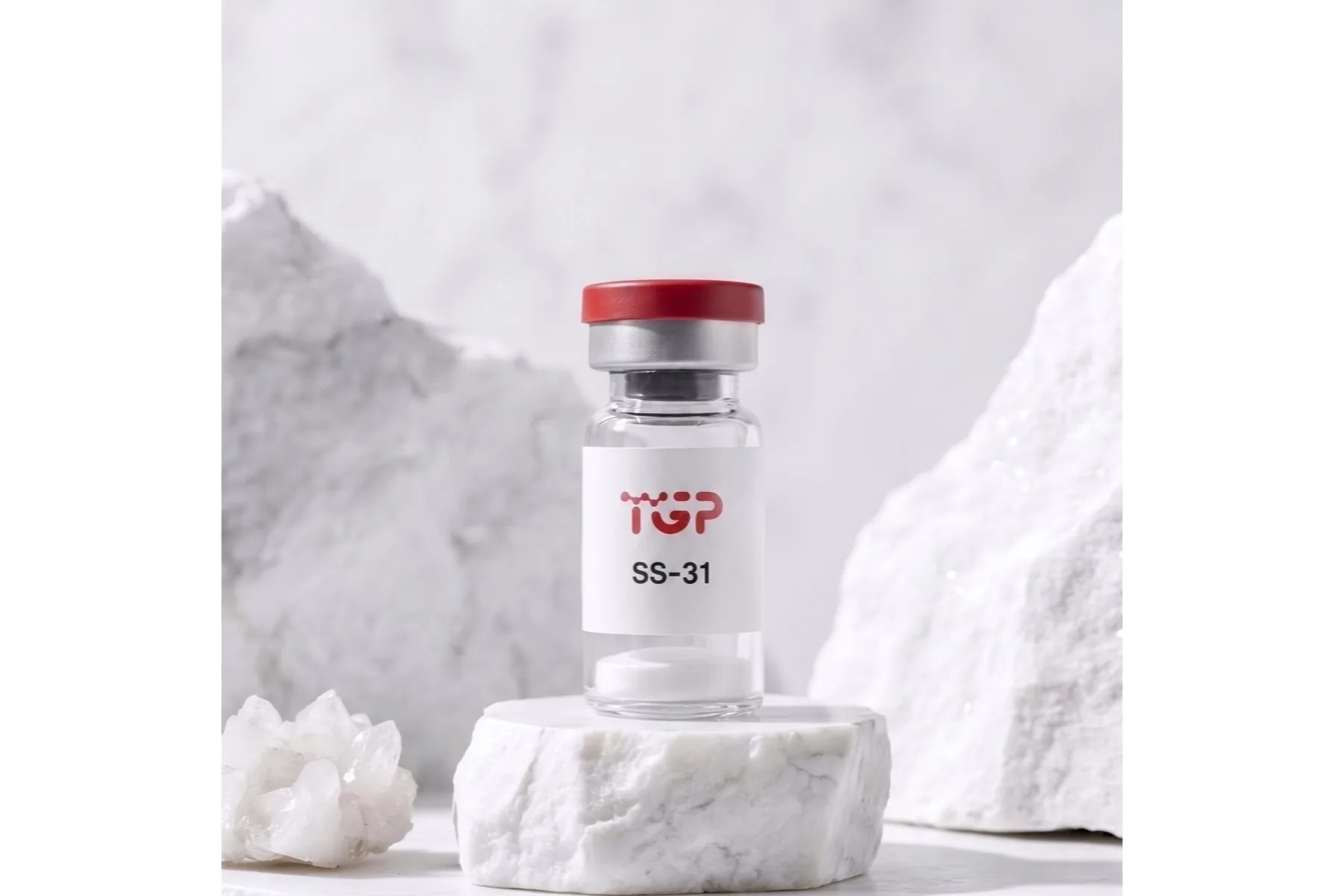
The solid, dry form makes freeze-dried peptides less sensitive to temperature fluctuations during shipping than liquid formulations, which offers logistical advantages since not every shipment requires an uninterrupted cold chain, although cool, dry storage upon receipt remains advisable for long-term stability. The low weight and volume of the freeze-dried powder, typically in the form of a compact pellet or cake in the vial, also simplify packaging and storage in the laboratory.
Dissolving for analysis
For an in-vitro analysis, the freeze-dried peptide is dissolved in the laboratory in a suitable solvent, such as purified water, dilute acetic acid, or another laboratory solvent depending on the physicochemical properties of the peptide. The solvent is preferably added along the wall of the vial to limit foaming, after which the vial is gently swirled rather than shaken, to avoid denaturation of the peptide from mechanical stress. Once in solution, the peptide is subject to the same stability limitations as any aqueous peptide solution.
- Freeze-drying: freezing followed by sublimation of water under vacuum
- Removing free water slows hydrolysis, deamidation, and oxidation
- Transport advantages: less temperature-sensitive, compact volume
- Dissolving for analysis requires a suitable solvent and careful handling
- Intended for laboratory and research use only