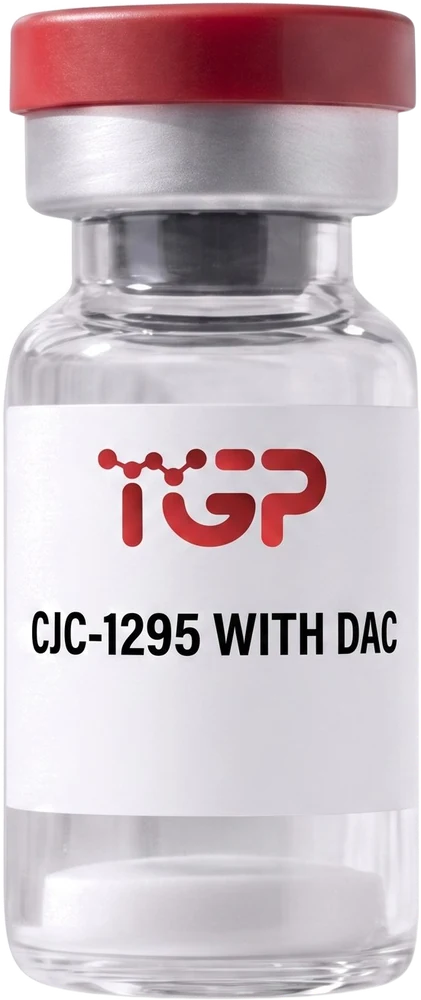
CJC1295 with DAC
€58.99€89.99
Today only on the entire range
02:14:33
Research only
In short
CJC-1295 (DAC) is a Groeihormoonbooster (langwerkend); its molecular target in research is Spieropbouw · anti-aging. Offered strictly for laboratory research, with a certificate of analysis (CoA) per batch on request.
For laboratory and research use only. Not for human or animal consumption, diagnostics or therapeutic use.
TogoPeptide Research Team · Research & quality
Research-only. Fact-checked, no medical or dosing claims. Every batch with a CoA. CoA
CJC-1295 with DAC is a synthetic GHRH analogue used in preclinical research as a model compound for the pituitary growth-hormone axis. Conjugation to a Drug Affinity Complex (DAC) allows the molecule to bind covalently to serum albumin, producing a markedly extended plasma half-life in research models compared with the unconjugated peptide.
Supports growth hormone and deep sleep
Made fresh to order
12 people are viewing this now
| Type | Groeihormoonbooster (langwerkend) |
|---|---|
| Form | Freeze-dried powder |
| Purity | As stated on the batch CoA |
| Certificate | Per batch, on request |
| Use | Research only |
The molecule is built on the GRF(1-29) fragment, the biologically active portion of native GHRH, with amino acid substitutions at specific positions that increase resistance to degradation by DPP-IV and other proteases. In receptor-binding studies, this modified sequence shows high affinity for the GHRH receptor, a class B G protein-coupled receptor expressed on somatotroph cells of the anterior pituitary. Receptor activation triggers the adenylate cyclase/cAMP/PKA pathway in model systems, the signalling cascade governing growth-hormone synthesis and release.
DAC consists of a maleimidopropionic acid linker that, once introduced in research models, reacts covalently with a free thiol group on cysteine-34 of circulating serum albumin. This albumin binding shields the peptide from enzymatic degradation and rapid renal clearance. Pharmacokinetic studies in animal models report an elimination half-life spanning several days for the DAC-conjugated form, compared with only minutes for the unconjugated GHRH fragment.
In laboratory settings, the compound is applied in receptor-binding and signal-transduction assays, in studies of growth-hormone axis pulsatility, and in research on downstream IGF-1 signalling. It also serves as a reference compound in comparative research against the non-DAC variant (Mod GRF 1-29), mapping pharmacokinetic differences between short- and long-acting GHRH analogues within controlled model systems.
A CoA confirms batch purity via HPLC and molecular identity via mass spectrometry, alongside screening for microbial load and endotoxins. Documented batch-to-batch consistency is essential for reproducible research outcomes: variation in purity or unintended by-products can skew readouts in receptor or pharmacokinetic assays.
Related products
Certificate of analysis per batch and shipping from the EU.