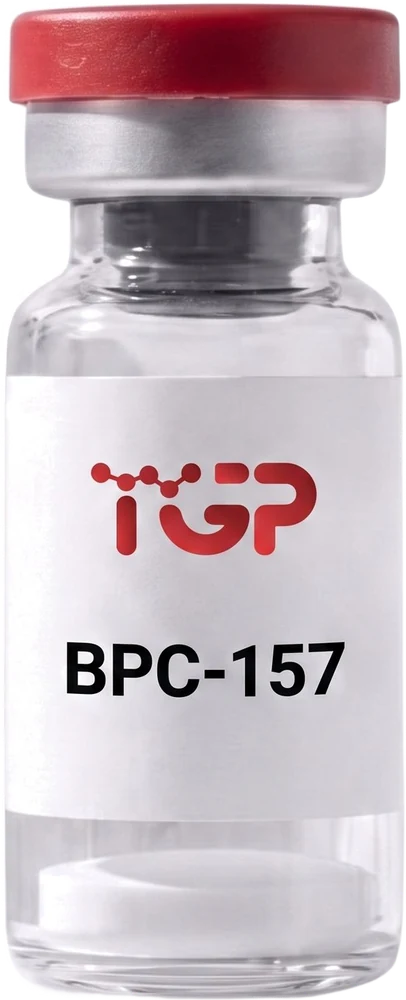
BPC-157
€34.99€53.99
Today only on the entire range
02:14:33
Research only
In short
BPC-157 is a Herstelpeptide (Wolverine); its molecular target in research is Pezen · gewrichten · darmen. Offered strictly for laboratory research, with a certificate of analysis (CoA) per batch on request.
For laboratory and research use only. Not for human or animal consumption, diagnostics or therapeutic use.
TogoPeptide Research Team · Research & quality
Research-only. Fact-checked, no medical or dosing claims. Every batch with a CoA. CoA
BPC-157 is a synthetic pentadecapeptide, a fifteen-amino-acid fragment modeled on a partial sequence of a protein identified in gastric juice. Laboratory and animal-model research examines its role in cellular signaling pathways linked to tissue regeneration and angiogenesis, the formation of new blood vessels from existing vasculature.
Known for muscle and joint recovery
Only 6 left in stock
39 people are viewing this now
| Type | Herstelpeptide (Wolverine) |
|---|---|
| Form | Freeze-dried powder |
| Purity | As stated on the batch CoA |
| Certificate | Per batch, on request |
| Use | Research only |
BPC-157 (Body Protection Compound-157) is a pentadecapeptide with the sequence Gly-Glu-Pro-Pro-Pro-Gly-Lys-Pro-Ala-Asp-Asp-Ala-Gly-Leu-Val. The sequence derives from a fragment of a human gastric protective protein. In vitro, the molecule shows relative stability under acidic conditions, making it a frequently used model compound in structure-function research on short peptide fragments and their interaction with cell-surface receptors.
Cell-culture research examines BPC-157 in connection with the VEGFR2 pathway (vascular endothelial growth factor receptor 2), a central mediator of angiogenesis. Additional research addresses the FAK-paxillin axis (focal adhesion kinase-paxillin), an intracellular signaling chain that governs cell adhesion and migration. These pathways are studied to understand how short peptides can influence cellular behavior at the molecular level.
Preclinical research on BPC-157 concentrates on three main lines: tissue-repair processes in animal models, angiogenesis and cell-migration studies based on endothelial cell cultures, and in-vitro fibroblast models measuring migration and proliferation rates following exposure to the peptide. These models generate mechanistic insight relevant to fundamental cell biology, independent of any application in humans or animals outside a laboratory context.
For researchers, a Certificate of Analysis (CoA) is essential when selecting a BPC-157 batch. A CoA confirms, through HPLC and mass-spectrometry analysis, the purity and sequence identity of the peptide, ruling out deviant batches that could produce non-reproducible results. Reproducibility is a core requirement in peptide research, and batch-specific documentation allows meaningful comparison between experiments.
Related products
Certificate of analysis per batch and shipping from the EU.