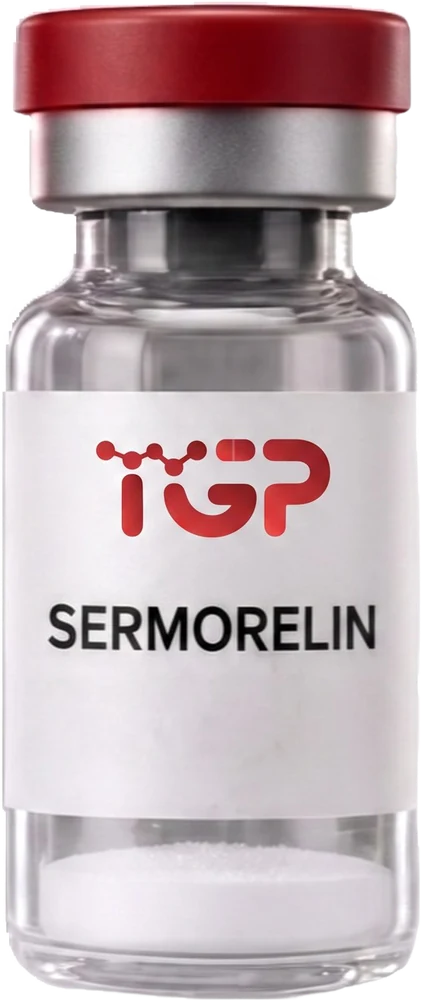
Sermorelin Acetate
€47.99€73.99
Today only on the entire range
02:14:33
Research only
In short
Sermorelin is a GHRH(1-29) analog; its molecular target in research is GHRH-R. Offered strictly for laboratory research, with a certificate of analysis (CoA) per batch on request.
For laboratory and research use only. Not for human or animal consumption, diagnostics or therapeutic use.
TogoPeptide Research Team · Research & quality
Research-only. Fact-checked, no medical or dosing claims. Every batch with a CoA. CoA
Sermorelin is studied preclinically as a synthetic GHRH analogue comprising the first 29 amino acids of native growth hormone-releasing hormone. As a truncated fragment variant, the molecule serves as a reference peptide for research into GHRH receptor binding, signal transduction in pituitary cell models, and the broader pharmacology of the GHRH-analogue class.
Supports growth hormone and deep sleep
In stock: 17 units
7 people are viewing this now
| Type | GHRH(1-29) analog |
|---|---|
| Form | Freeze-dried powder |
| Purity | As stated on the batch CoA |
| Certificate | Per batch, on request |
| Use | Research only |
Native GHRH is a 44-amino-acid peptide, but the biologically active domain resides in its N-terminal segment. Sermorelin corresponds to this first 29-residue fragment, GHRH(1-29), which retains the epitope responsible for receptor recognition while presenting a shorter, more synthesis-friendly chain. This truncation is a recurring theme in GHRH-analogue design, where researchers study how sequence length relates to receptor affinity, in vitro stability, and susceptibility to enzymatic degradation.
The GHRH receptor (GHRH-R) is a class B G-protein-coupled receptor expressed on somatotroph cells within pituitary tissue used in ex vivo and cell-culture models. In these preclinical systems, GHRH-R activation triggers a signalling cascade from adenylate cyclase to cAMP to protein kinase A, a pathway researchers quantify through cAMP-accumulation assays and receptor-binding studies to characterise ligand-receptor kinetics.
Published preclinical work situates Sermorelin within GH-axis regulation studies, typically using rodent models and isolated pituitary cell systems. Comparative pharmacology within the GHRH-analogue class is another active area, where structural modifications introduced in longer-acting analogues are benchmarked against the Sermorelin fragment as a reference point. In vitro peptide-stability and degradation research also relies on Sermorelin to model how chain length affects enzymatic breakdown.
Peptide synthesis introduces batch-to-batch variability, so a Certificate of Analysis (CoA) confirming identity through mass spectrometry and purity through HPLC is a baseline requirement for reproducible experimental design. Without verified identity and purity data, GHRH receptor-binding results and comparative analogue studies cannot be reliably interpreted or replicated across laboratories.
Related products
Certificate of analysis per batch and shipping from the EU.